Abstract
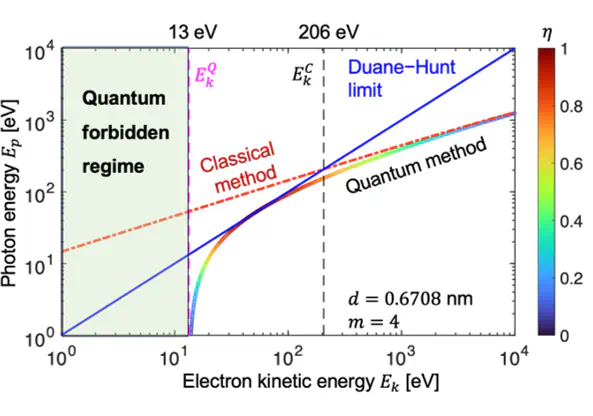
Smith-Purcell radiation has emerged as a crucial platform for investigating light-matter interactions and developing compact, tunable light sources that span from microwaves to X-rays. In classical theory, it is believed that Cherenkov radiation exhibits an energy threshold for electrons, while Smith-Purcell radiation is considered free of such a threshold. Although quantum theory suggests there is an emission cutoff in Smith-Purcell radiation, the behavior of this radiation near the threshold remains understudied. In this article, we address this gap by examining the behavior of Smith-Purcell radiation near the threshold from quantum perspectives. Specifically, we derive a quantum energy threshold based on energy-momentum conservation, providing a rigorous limit for the onset of Smith-Purcell radiation. Furthermore, we find that around the threshold the incident electron emits a photon and subsequently reverses its direction of motion. Additionally, we establish a classical energy threshold—below which the classical theory breaks down—by applying the Duane-Hunt limit to Smith-Purcell radiation. Accordingly, quantum theory is required when the electron energy falls between the classical and quantum thresholds. Our findings enrich the understanding of Smith-Purcell radiation and provide valuable insights for developing low-energy-driven and heralded quantum light sources.